Categories
Books

The great American elsewhere …

At first it seemed odd, reading Hank Stuever’sOff Ramp” while swilling rum and watching the waves in Jamaica. The book is subtitled “Adventures and Heartache in the American Elsewhere.”

But it didn’t take Stuever long to bring the great American elsewhere to my little island. As I was reading his meditation on the omnipresence of the plastic chair, I looked up to spy a whole herd of said chairs milling around right there between me and the Caribbean Sea. Small world. And in many ways, that’s the point of Stuever’s writing. It’s not the grandiose that catches his eye. It’s the small things — plastic chairs, two regular kids getting married, the guy whose couch is too big to be carried up the stairs — that reveal so much about what it’s like to live in early 21st century America. Hank sweats the small things, putting them under the microscope and marveling at them, revealing more about life than a hundred Kerry campaign stories ever will.

To quote Hank: “The great American Noplace makes sense to me as a journalist preoccupied with how life feels, and what it’s like to live in milennial times.”

That sense of milennial times reverberates throughout the slices of life in his book, a collection of stories he wrote while working at the Albuquerque Tribune, the Austin American-Statesman and most recently, the Washington Post. The big bang. Space. Emptiness. A creeping sense of entropy filters through these meditations, but it’s always countered by flare-ups of simple beauty and the glow of common people being wonderfully common.

I worked with Hank in Albuquerque, and I’ve been a fan from the start. I’ve engaged in boozy, heated arguments over the merits of Hank’s style of journalism, coming to his defense when the “hard news” whores wanted to write Hank off as fluff. I’m amazed at how much he’s grown as a writer in the past decade or so. I’d argue he’s one of the best journalists of our time.

I guess the only criticism I have of “Off Ramp” is the “updating” that’s grafted onto the end of several stories. It’s sometimes abrupt and a bit, well, after the fact. It feels almost like a Dragnet epilogue. It’s the peril, I guess, of pulling together stories that were written several years ago. And it’s almost as jarring when there is no update. I can’t help but wonder: What ever happened to Andy and Darlene, the two kids whose wedding Hank chronicles in unflinching detail? Are they still married? What are they doing now? How did life work out for them?
Categories
Travel Bob

The tree of life …

July 11, 2004 — I’ve become obsessed with identifying things. I sit here, staring seaward, a stack of books on the flora and fauna of the West Indies beside me, and I wait for things to drift into view, where I will then bestow them with a name.

It reminds me, vaguely, of the Judge in Cormac McCarthy’s Blood Meridian. There’s a traffic cop in all of us, wanting to slow things down, make nature obey the rules and document it all in a handy police blotter. In his bloody rampage through Texas, Mexico and the Southwest, the Judge stops frequently to draw and catalog little bits and pieces of nature and artifact. Why does he do it?

“Whatever in creation exists without my knowledge exists without my consent,” he tells Toadvine. The judge, pedophile, philosopher, man of letters, naked savage, is really about dominating and subjugating all around him. “The man who believes that the secrets of the world are forever hidden lives in mystery and fear. Superstition will drag him down. The rain will erode the deeds of his life. But that man who sets himself the task of singling out the thread of order from the tapestry will by the decision alone will have taken charge of the world and it is only by such taking charge that he will effect a way to dictate the terms of his own fate.”

Well, maybe my impulses aren’t quite like the Judge’s. But they’re just as obsessive. Take my encounter with Lignum Vitae, the tree of life. While furiously shuffling between James Bond’s “Birds of the West Indies” and a tree with an odd avian perched in it, I started going through the process of elimination, trying to define the specific birdness of this bird. It had an odd beak, almost a hookbill but not. Could it be some sort of raptor? No. finally, I found it in the section on cuckoos. It was a smooth-billed ani.

But what kind of tree is that it’s sitting in?

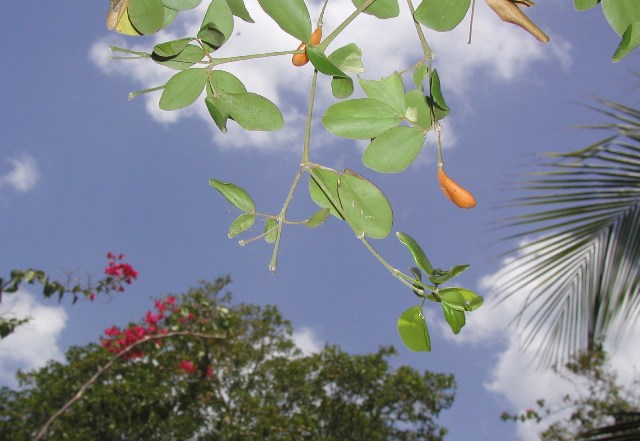
Back to the books. And this time I’m stumped. The tree has what look like orange flowes, but closer inspection reveals they are seed pods. I spend a lot of time looking for orange in the book on Caribbean trees. Could it be a cordia? Finally, I ask Miss Joyce. It’s the Lignum Vitae, the tree of life which also happens to be the national flower of Jamaica. It blooms purple in June then develops the orange seed pods that I was seeing.

Now Playing: Mark of the Beast from the album Live & Dangerous – Boston 1976 by Peter Tosh

Categories
Boobtube Bob Books Music Bob Web Bob

There’s a Mingus among us …

Snapped up a copy of Charles Mingus’ “Mingus Ah Um” the other day. It’s incredible. This is the remastered version with some new stuff added. I highly recommend it, even if you have only a passing interest in jazz.

Other cool, recent finds:

Trailer Park Boys: This Canadian show on BBC America is a scream. After three episodes, I’m officially hooked. It’s shot like a reality TV thingy, and the characters are constantly talking directly to the audience and making reference to the sound and cameraman. Keep an eye out for Bubbles, the Trailer Park Buddha behind the Coke-bottle glasses.

During one of my regular surfs of Cruel.com, I came across IWorkWithFools.com. Some pretty amusing stuff in there, and I get the frightening feeling it’s not fiction.

Now Playing: Ooh Bop Sh’Bam from the album Charlie Parker Carvin The Bird by Charlie Parker Carvin The Bird